Showing posts with label Trout. Show all posts

Saturday, November 12, 2022

Bergman's brook trout:  I truly dislike painting reproduction pieces of other people's work, but my husband pleaded with me to do a watercolor of a famous, and favorite, image of his.  The original painting, titled The Male Eastern Brook Trout, graced the cover of Ray Bergman's book--- Trout, and was painted by noted artist/author/angler William J. Schaldach.

Bergman (NFS):


Saturday, April 20, 2019

Trout Unlimited donations:  Below are two recent watercolor donations to the Ashokan-Pepacton Watershed Chapter of Trout Unlimited, and their 31st Annual Conservation Dinner in April 2019.

The first is of autumn on Chimney Hole, the mouth of New York City's Ashokan Reservoir and part of the Esopus Creek, where in 1923 T.E. Spencer of Shokan caught a 19 lb., 14 oz. brown that was the NYS record for many years.

Chimney Hole, Esopus Creek II (DtC)


For a fly fisher, there's no reel quite like a Hardy fly reel and no Catskill trout like a wild brook trout--- Salvelinus fontinalis.

Hardy and brook trout II (DtC)


Wednesday, August 1, 2018

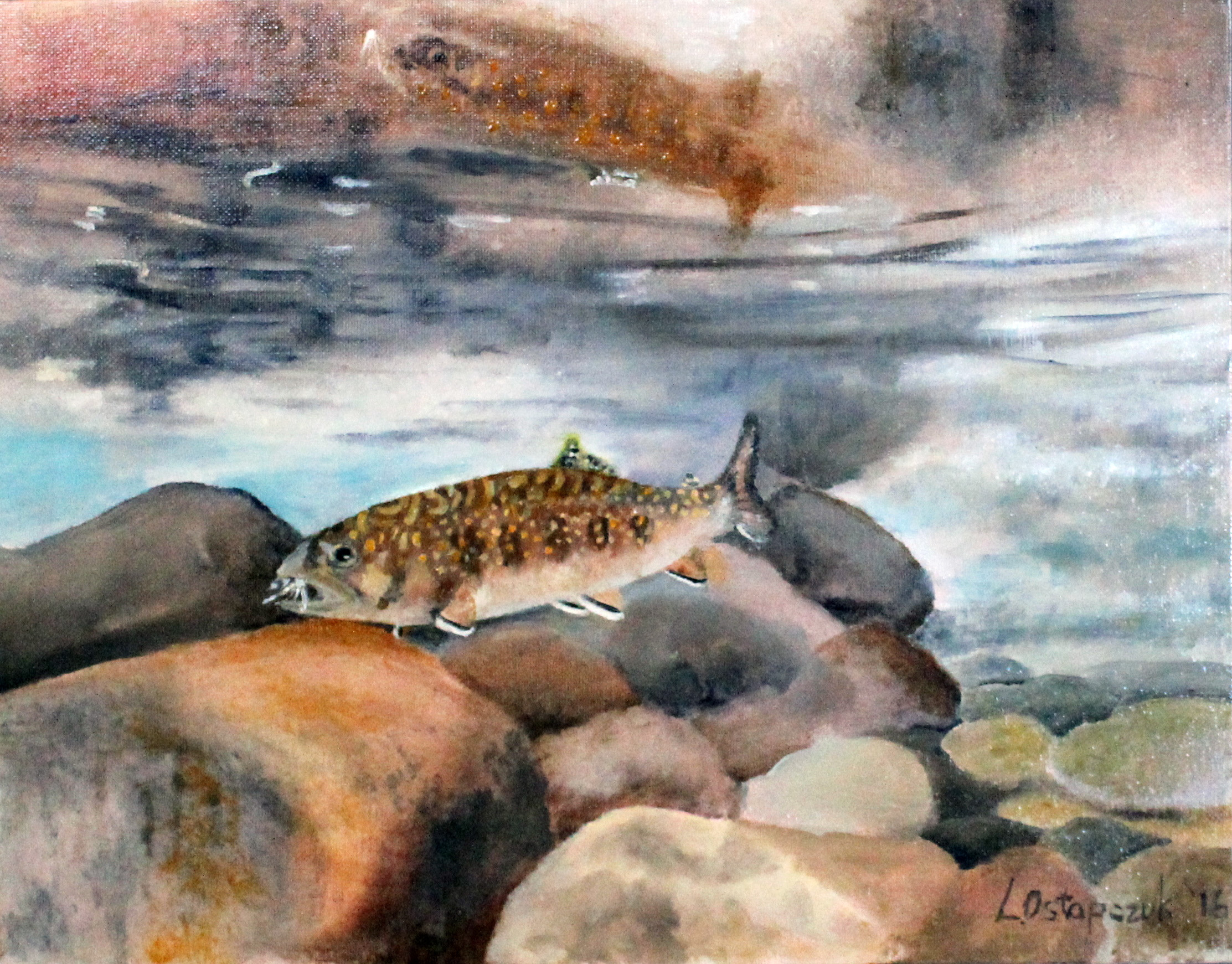
Yet another brook trout:  During the summer of 2017, lurking on the bottom of the upper Neversink was a brook trout, stealthy and poised for the next morsel to pass its way.

Lurking:


Tuesday, February 27, 2018


Flyfishers, the Esopus, and brook trout:  Big Bend, a fisherman’s landmark on the Esopus Creek.  It was a favorite of the late Arnold Gingrich, noted author, flyfisher, and a founder of Esquire magazine.  The idyllic scene from above has graced the pages and covers of many publications.

Big Bend, Esopus Creek (DtC):


Not far away, upstream as the crow flies, lies Jennings Pool.  Preston Jennings was another noted Esopus flyfisher, and friend of Arnold Gingrich.  He often cast his offering in this Mt. Tremper pool, viewed below in autumn attire.

Autumn on Jennings Pool (Sold):


The New York State is the native brook trout, no small wonder why given the colorful garb it wears.  The one below took up residence in the East Branch of the Neversink, a watershed home to such flyfishers as Theodore Gordon, Edward R. Hewitt, Leonard Wright, Ed Sens, and many others.

East Branch Neversink brook trout (Sold):


Monday, January 29, 2018

Life’s reflection and more Catskill watercolors:

Why (DtC):


A question living creatures often ponder, this one at the bottom of a stream with reflections of a clear net--- from above--- all about.  Why, why am I here with a fly stuck in my jaw?  Why can’t I move freely about and why is that unfamiliar round thing behind me?  Why are the lines of refracted light in such odd patterns?  Why are you and I so up close and personal?  But perhaps most pressing, why are you anglers so in love with me most of all?


A Catskill Hollow (NFS):


What is it about a hidden Catskill hollow some find so alluring?  Is it because nature fondly calls these places home?  Could it be many are the birthplaces of mighty waterways?  Perhaps the small wild trout have something to do with this affection?  Maybe on this misty, foggy, drizzly day, the very elements of life are alive in this damp, cool ravine?


Friday, January 19, 2018

Catskill brook trout:  Salvelinus fontinalis, a native New York trout, although taxonomically it’s actually a char and not a true trout.  Historically brook trout were the only Catskill trout, but nowadays brookies might not be the largest nor most cunning fish in these mountains.  However, there’s little doubt brook trout are still the prettiest of the bunch, especially in autumn spawning attire.  Typically brook trout require the coldest and purest of waters, even if it’s a little acidic.  As such development, pollution, and competition from other trout species tend to reduce the brook trout’s current range to headwater streams and small tributaries.  Typically a six-inch Catskill brook trout might be a decent size while a foot-long fish a real trophy, though in ponds and lakes brook trout can grow in stature.

How can any serious fly-fishing fanatic not love the bodily colors of a wild Catskill brook trout?  These vibrant fish are both the hunted and the hunters.


The hunter (DtC):


This trout is poised in attack mode, patiently postured for a fleeting morsel to approach within striking range.


Bewilderment:


Confused by the sting of a Brown Bivisible stuck in its jaw and a slight tug from a tippet--- working to redeploy this fish from the creek bottom’s safety, it fins in bewilderment.


A Gunks brookie (Sold):


Not all wild regional brook trout are only found in the Catskills, some might make their homes under the shadows of the Shawangunks, in white conglomerate bedrock streambeds.


Hardy and the brook trout:


Perhaps one of the most prized fly reels ever manufactured, a Hardy reel and a brook trout make unlikely unwater acquaintances.


Traver’s trout:


This watercolorist only paints original venues, refusing to mimic the work of another artist.  However, a persistent husband pleaded that she paint this scene for him, so she acquiesced.  The work was originally portrayed by Samuel A. Kilbourne (1836-1881) and later graced the covers of old Orvis catalogs and Robert Traver’s book, Trout Madness.


Sunday, August 14, 2016

Coxing Kill trout:  The Shawangunk Mountains--- or Gunks are they are known--- run from Kingston south to Port Jervis, the eastern ridge of the Appalachian Mountains.  While this name has a Dutch derivative, Native Americans referred to the Gunks as “smoky air.”

In Edward G. Henry’s handbook--- Gunks Trails--- the author wrote, “If the Shawangunks were said to have a heart, it would be the Trapps and Sky Top. … The Trapps titled, hard strata boldly rise from the small, glacier-enhanced gap.  The Delaware Indians used this mountain pass as a major war trail.  The Trapps is Dutch name meaning ‘staircase’, but the name was actually applied to a small settlement below the cliffs.”

Coxing Clove is centered by the Trapps and Sky Top; it was first settled in the late 1700s primarily by inhabitants of Dutch descent.  Lake Minnewaska is also found here, out of which drains a branch of the upper Coxing Kill flowing downstream through the glacier gap.  This lake was once known as Coxing Pond.

The Delaware Indians and Dutch are long since gone, as is the Trapps hamlet.  Perhaps today this area is best known for its world-class rock climbing, but brook trout are still to be found.

Coxing Kill trout, 11x14 (Sold):


Tuesday, May 3, 2016

Brook trout and the NYS Conservationist:  Ever so often a photograph we take while hiking or fishing these Catskills is used by some agency, whether it is NYS DEC, USGS, Soil & Water, a local town, or someone else; and we are flattered, happy to be of help.  Recently the New York State Department of Environmental Conservation used one such photo, in their website announcing the 2016 trout season and also on the rear cover of the April issue of NYS Conservationist magazine.  That brook trout was caught, and released, on the upper reaches of the East Branch of the Neversink on September 3rd, 2015 using a #16 Sofa Pillow dry fly--- a western classic--- and an A.J. Thramer F.E. Thomas Fairy 3 weight cane rod, a sweet piece of bamboo for late summer brook trout fishing.

Not the typical landscape, but an underwater finny creature with scales and a fly stuck in its mouth.

But first, the April NYS Conservationist:


Brook trout and the Sofa Pillow, 11x14:


Monday, June 22, 2015

The brook trout:  A male brook trout in full spawning attire is perhaps the prettiest of all trout, though not a trout at all.  Salvelinus fontinalis, the Latin name for brook trout, is actually a member of the char family, a close relative of trout.  The historic indigenous distribution of brook trout includes the northeast portion of the United States and Canada, plus down along the spine of the Appalachian Mountains.  It was the only true native trout in the Catskills and New York State requiring the purest and coldest of waters.  In most of its remaining habitat a nine inch brook trout might be considered big, anything over a foot a monster.

The brook trout appearing in the painting below was caught, and released, back into its East Branch of the Neversink, one of the few remaining Catskill streams that still harbors a good population of wild brook trout, much like the days Theodore Gordon roamed these waters.

Salvelinus fontinalis 11x14 (SOLD):


Wednesday, February 5, 2014


Other pieces:  
Mother's Pool Rainbow Trout (DtC)–
The rainbow trout above was created on a thirty-six inch long aluminum blank--- cut out by the Orange County Choppers--- using acrylic paints.  It was one of many trout in the 2012 Leaping Trout Project of the Ashokan-Pepacton Watershed Chapter of Trout Unlimited.
Brook trout (DtC)- 

The book trout above was part of the 2011 Ashokan-Pepacton Watershed Chapter of Trout Unlimited's Leaping Trout Project.